Read more...
Panera Bread CEO Says Pay What You Can
Read more...
Goldman Sachs created the food crisis — “Foreign Policy” tells how they did it

' “Demand and supply certainly matter. But there’s another reason why food across the world has become so expensive: Wall Street greed. It took the brilliant minds of Goldman Sachs to realize the simple truth that nothing is more valuable than our daily bread. And where there’s value, there’s money to be made.
In 1991, Goldman bankers, led by their prescient president Gary Cohn, came up with a new kind of investment product, a derivative that tracked 24 raw materials, from precious metals and energy to coffee, cocoa, cattle, corn, hogs, soy, and wheat.
They weighted the investment value of each element, blended and commingled the parts into sums, then reduced what had been a complicated collection of real things into a mathematical formula that could be expressed as a single manifestation, to be known henceforth as the Goldman Sachs Commodity Index (GSCI).'
Read more...
Is There a Financial Scam Behind the Rise in Oil and Food Prices?
'When I met Phil the other night, he was on fire, enraged by what he believes is the scam of the century that no one wants to talk about, because so many powerful people armed with legions of lawyers want unquestioning allegiance, and will sue you into silence.
He studies the oil/food issue carefully and has concluded, “It’s a scam folks, it’s nothing but a huge scam and it’s destroying the US economy as well as the entire global economy but no one complains because they are ‘only’ stealing about $1.50 per gallon from each individual person in the industrialized world.”
“It’s the top 0.01% robbing the next 39.99% – the bottom 60% can’t afford cars anyway (they just starve quietly to death, as food prices climb on fuel costs). If someone breaks into your car and steals a $500 stereo, you go to the police, but if someone charges you an extra $30 every time you fill up your tank 50 times a year ($1,500) you shut up and pay your bill. Great system, right?”'
Read more...
The ‘food bubble’ is bursting, says Lester Brown, and biotech won’t save us
'In recent years, two factors have added urgency to Brown's warnings: 1) climate change has given rise to increasingly volatile weather, making crop failures more likely; and 2) the perverse desire to turn grain into car fuel has put yet more pressure on global grain supplies. Brown's central metaphor -- which he's been using at least since the mid-‘90s -- will be familiar to readers who've lived through the previous decade's dot-com and real-estate meltdowns: the bubble.
The world has entered a "food bubble," he argues; we've puffed up grain production by burning through unsustainable amounts of three finite resources: water, fossil fuels, and topsoil. At some point, he insists, the bubble has to burst.
Well, for the second time in three years, the globe is lurching toward a full-on, proper food crisis, especially in places like Haiti that have de-emphasized domestic farming and turned instead to the global commodity market for food. In 2008, global food prices spiked to all-time highs, and hunger riots erupted from Haiti to Morocco. Now prices are spiking again, and have already surpassed the 2008 peak, The Sydney Morning Herald reports.'
Read more...
You Are Being Warned
by Dr. Mark Sircus
Read More
What If Supermarkets Fail Us?
This Financial Catastrophe Can Destroy Your Future Fast - How to Avoid it
By Dr. Mercola
'Is the US headed toward an economic crisis that could dwarf the Great Depression?
Well, the signs are hard to ignore, and there are many striking similarities between events today and the events that led up to the harshest years during the Great Depression, from banking failures in the thousands and rising unemployment, to the passing of laws and creation of administrative boards later declared unconstitutional.
As reported by the Wall Street Journal, food prices have risen sharply in the past few months, and the food manufacturing and restaurant industries warn that further increases may be unavoidable, despite the risks involved:
"For food executives, how quickly to pass along higher costs presents difficult choices.
Missteps could be costly when the economy remains weak. Many Americans, nervous about high unemployment, have pledged allegiance to their pennies and are willing to trade down on brands, switch supermarkets, opt for Burger King over Applebee's, or stop dining out altogether to save money."'
Read more...
Missteps could be costly when the economy remains weak. Many Americans, nervous about high unemployment, have pledged allegiance to their pennies and are willing to trade down on brands, switch supermarkets, opt for Burger King over Applebee's, or stop dining out altogether to save money."'
Banksters Inflate Speculative Food Bubble, U.N. Offers Global Governance Solution
'Never let a good crisis go to waste. The international bankers are taking advantage of the "food crisis" by driving up food prices in what is shaping up to be a classic case of a manufactured bubble. It is also looking like a clear model of Problem-Reaction-Solution methodology. Create the food inflation problem (of course profiting all the way up), force an enraged reaction among the public, and take more sovereignty away with the solution of global food regulation.'
Read more...
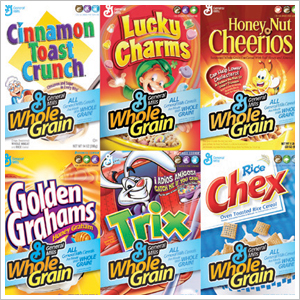
General Mills Signals Faster U.S. Food Inflation: Chart of the Day

View Chart (a must view)
How the financial markets create hunger and make huge profits
'The deregulation of global agricultural markets was part of the economic deregulation driven by the World Trade Organization (WTO), the World Bank and the International Monetary Fund. It was a process initiated by the Breton Woods Agreements of 1944 to standardize international trade and marketing policies to facilitate global trade [9].
'It eliminated government intervention in agricultural markets, dismantling global commodity agreements, price supports, and other mechanisms that had helped stabilize global supplies and prices. The WTO’s Agreement on Agriculture, and other multi-lateral and bilateral free-trade agreements including the North American Free Trade Agreement (NAFTA), opened up markets in the developing world to an increasingly powerful global agribusiness industry.
The consequence of deregulation was [10] “to replace local market access for the majority of small farmers with global market access for a few global transnational companies. Thanks to non-existent anti-trust enforcement and rampant vertical integration, [t]hree companies - Cargill, Archer Daniels Midland (ADM), and Bung - control the vast majority of global grain trading, while Monsanto controls more than one-fifth of the global market in seeds.”'
Read more...